|
Home
About Us
Bookstore
Links
Blog
Archive
Books
Cinema
Fine Arts
Horror
Media & Copyright
Music
Public Square
Television
Theater
War & Peace
Affilates
Horror Film Aesthetics
Horror Film Festivals
Horror Film Reviews
Tabloid Witch Awards
Weekly Universe
Archives

|
A FREE SPEECH CULTURE GOES BEYOND THE FIRST AMENDMENT
by Thomas M. Sipos,
managing editor [March 21, 2026]
 [HollywoodInvestigator.com]
Libertarians and conservatives often
say: "You are free to speak. You are not free of the
consequences." This is their way of saying, with approval, that
the First Amendment only forbids the government from banning speech.
But if you lose your college admissions, business partners, customers,
jobs, platforms, or friends and family because of what you say, well
then, tough. That's the "free market" at work. [HollywoodInvestigator.com]
Libertarians and conservatives often
say: "You are free to speak. You are not free of the
consequences." This is their way of saying, with approval, that
the First Amendment only forbids the government from banning speech.
But if you lose your college admissions, business partners, customers,
jobs, platforms, or friends and family because of what you say, well
then, tough. That's the "free market" at work.
I disagree. While their interpretation of Constitutional law is
accurate, the market is not moral, and not all consequences are just
or conducive to a free society.
Whereas the First Amendment is a legal doctrine, free speech is a
cultural value. And in a free culture, people do not dox or harass,
bankrupt or destroy, anyone who expresses opposing opinions. They do
not pressure universities, employers, service providers, or social
circles to expel thought criminals.
The First Amendment guarantees a politically free society. But a
politically free society isn't necessarily culturally free.
Private sector actors, apart from government, can oppress freedom just
as effectively.
During our recent COVID hysteria, I
felt as if I were living in Communist Romania, a nation I visited
during the 1970s (and inspiration for my novel,
Vampire Nation). As I crossed into Romania, I felt the atmosphere
grow oppressive. The same atmosphere I felt in Los Angeles in 2020,
with the masks, and social distancing, and kneeling to George Floyd.
People often wore masks or kneeled not because the law demanded it,
but because private individuals and businesses monitored and harassed
those who didn't. An intolerant culture was enough to enforce
compliance; no laws required. People who refused, or questioned the
narrative, risked being harassed by Antifa, BLM, random "Karens," and
various private sector busybodies.
You don't need laws to destroy freedom. Civil society can crush
freedom without state intervention. Politically free people are not
necessarily free.
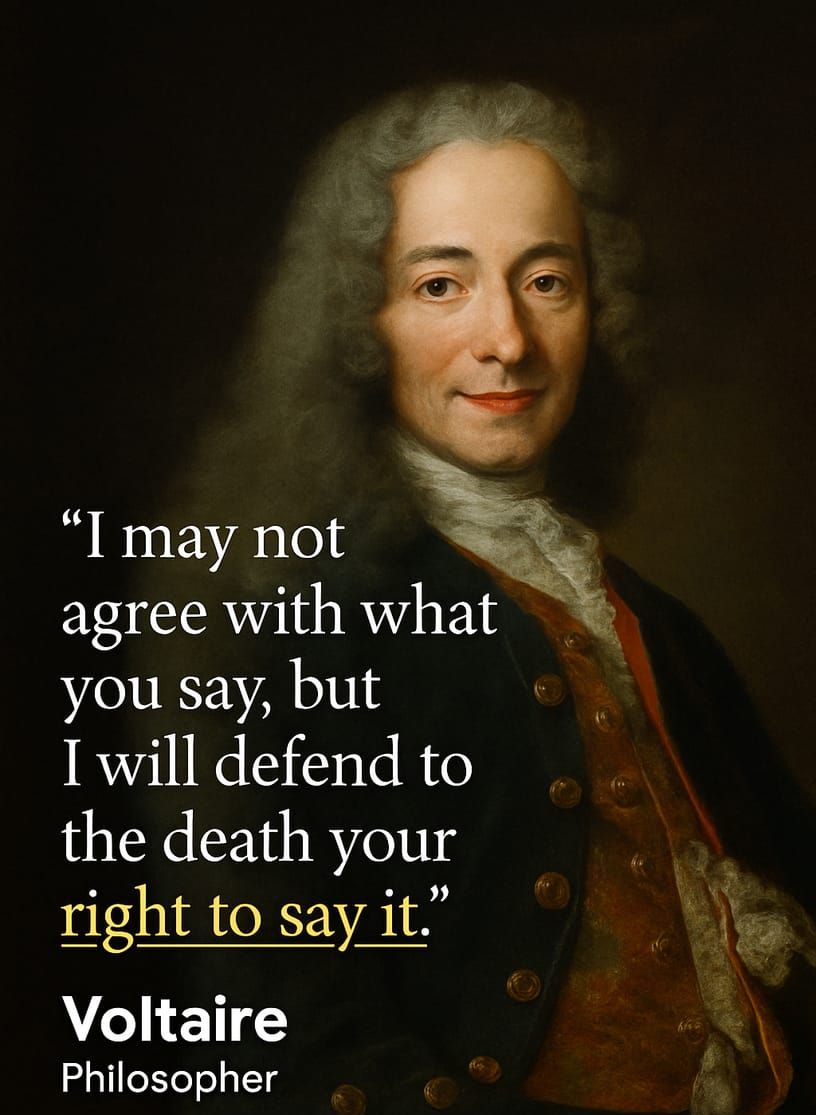
A free culture values free speech for its own sake. It's a culture
whose people proudly cite Voltaire: "I may not agree with what you
have to say, but I shall defend to the death your right to say it."
Voltaire's statement might be apocryphal, but it's a beautiful
sentiment. It conveys a generosity of spirit that celebrates not only
the right to speak, but to be respectfully heard. Not to be free of
disagreement, but free of harassment or intimidation. One does not
express a willingness to die for a "right" that can then be so easily
quashed by the private sector.
In the 1970s, public figures, conservative and liberal, often quoted
Voltaire with approval. It was a decade when a Jewish ACLU lawyer,
Aryeh Neier, defended the right of Nazis to march in Skokie, Illinois
(the topic of his book,
Defending My Enemy).
Having seen Communism first hand, being the son of refugees from
Communism, I hate Communism as much as anyone. Yet when, out of morbid
curiosity, I
visited the New York City offices of the Communist Party, USA in
1977, my disgust was balanced with pride that I lived in a country so
free that even the vilest of people could rent an office and appear on
the election ballot.
But those were the 1970s. I no longer hear Voltaire quoted today.
On both left and right, there have always been people intolerant of
speech. But they seem louder and more numerous than in decades past.
They no longer hide their desire to "cancel," but boast of it. While
the left tries to unperson "Covidiots" and "racists," the new Neocons
(NeoNeocons?) seek to unperson those critical of Israel or the Iran
War.
Filmmaker Sacha Baron Cohen has argued that the right to speak does
not mean the right to a platform. Some libertarians would agree,
citing the "property rights" of Big Tech platform owners. But those
"property rights" rest on shaky ground, considering the internet was
built on public utilities, or that Big Tech lobbies for
regulations that ensure
their dominance and block competitors, or is largely funded by
government contracts.
Ironically, while a free culture protects more speech than
does the First Amendment, the private sector can, and often does,
restrict for less speech than is protected by the First
Amendment. Thus, as our culture grows intolerant, government
increasingly
outsources speech restrictions to private sector companies.
Finally, the debate over speech restrictions is not about about
"offensive" speech, though it's often presented that way. People don't
seek to restrict speech because it offends, but because they fear it
doesn't. They fear their neighbor, rather than offended, might enjoy
it, and even be convinced by it.
An intolerant culture is a low-trust culture. Free speech is seen not
only as offensive, but dangerous. A view that is alien to the
high-trust Western cultures of decades past.
I prefer we foster a high-trust culture, tolerating speech far beyond
what the First Amendment permits. Not a low-trust culture with
outsourced corporate censorship and private sector "Karens." Not
merely a politically free society, but one that is culturally free. A
society whose people might disagree with what they hear, sometimes
vehemently, but always with a Voltairean spirit.
|